
Cities speak in color, texture, and rebellion—but without the right vocabulary, much of their meaning gets lost. This guide explores the vibrant world of urban art beyond the catch‑all term ‘graffiti,’ helping you recognize the distinct styles that transform blank walls into cultural statements. From towering murals to sharp-edged stencils and layered wheatpastes, each form carries its own history, technique, and purpose. If you’ve ever walked past a striking piece without knowing how to describe it, you’re in the right place. By the end, you’ll see your city not as concrete and glass, but as a living, open-air gallery waiting to be read.
Graffiti and Tagging: The Foundational Handstyles
Back in the late 1960s, as aerosol spray paint became cheap and widely available, modern urban art found its voice on subway cars and brick walls. What began as names scrawled in marker evolved—by the mid-1970s—into a visual language built on speed, risk, and identity. While critics still argue it’s vandalism, supporters see it as one of the most influential street art styles of the last fifty years (the debate, like the paint, sticks).
To understand the culture, start with its core forms:
- Tags – A tag is a stylized signature, essentially an artist’s personal logo. Quick to execute, it’s about repetition and recognition. The more places your name appears, the stronger your reputation.
- Throw-Ups – Emerging in the early 1970s, throw-ups use rounded “bubble” letters and usually two colors. They’re larger than tags but still designed for speed.
- Pieces – Short for “masterpieces,” pieces developed as artists competed for complexity. These multi-color works showcase lettering skill, composition, and color theory.
Admittedly, some say the progression from tag to piece glorifies property damage. Yet historically, it also reflects artistic growth—moving from raw signature to fully realized mural over just a decade.
The Power of the Cut: How Stencil Art Works
Stencil art starts with a simple idea: cut a design into a rigid surface—cardboard, acetate, or plastic—then spray or roll paint over it to transfer the image. The cut-out areas allow pigment through, creating crisp lines and repeatable forms. Think of it as a reusable template (like a custom stamp, but cooler).
Stencil vs. Freehand:
• Speed: Stencils win. A complex portrait can be applied in seconds.
• Precision: Clean, sharp edges beat the organic unpredictability of freehand.
• Replication: One design, multiple surfaces—walls, canvas, posters.
Freehand offers spontaneity; stencils offer control. If graffiti is jazz, stenciling is sampling—intentional repetition with impact.
Because of that bold clarity, stencils dominate political messaging in street art styles. High contrast equals high visibility (and high memorability).
DIY hack: Freezer paper or old file folders make surprisingly durable stencils. Pro tip: light adhesive spray prevents paint bleed for sharper results.
Muralism: Transforming Walls into Monumental Narratives
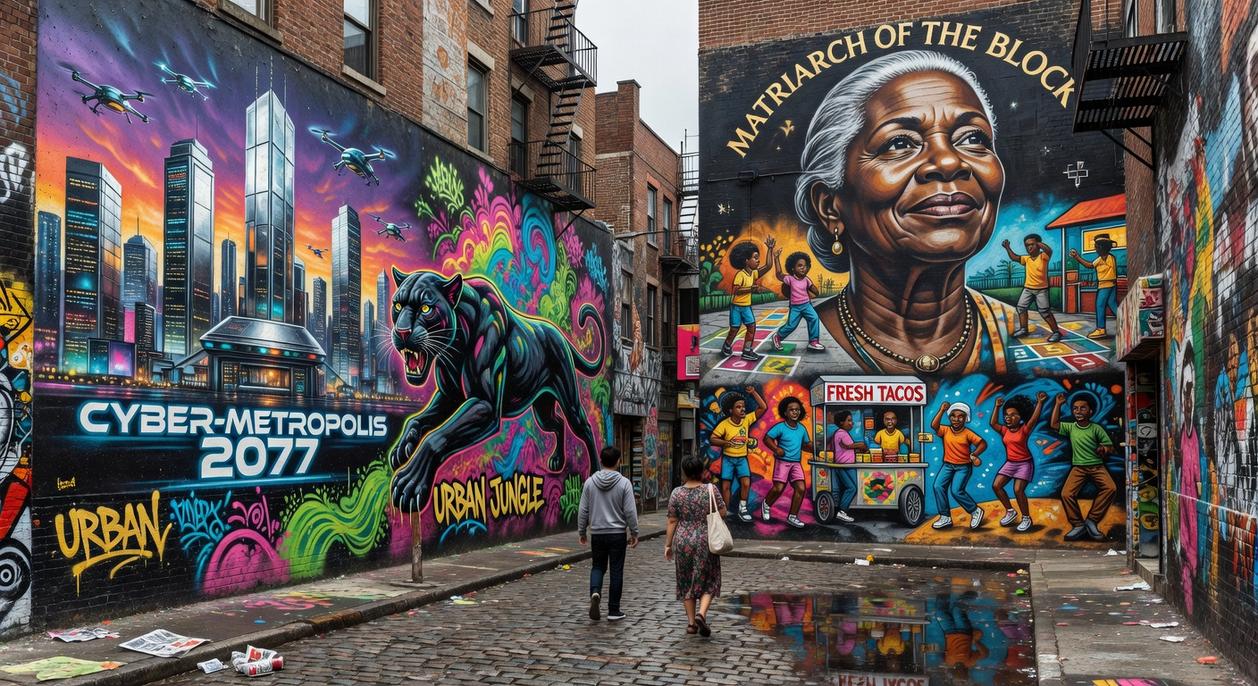
At first glance, some critics lump murals in with graffiti, arguing that both cover public walls with unsolicited imagery. However, that comparison misses a crucial distinction. Murals are typically commissioned, legally approved, and carefully planned artworks, often backed by city councils, nonprofits, or private businesses. Graffiti, by contrast, is usually unsanctioned. The difference isn’t just legal—it’s intentional. Murals are designed to serve a community purpose, not just personal expression.
In many cities, murals function as a community canvas—a shared visual space that reflects local identity. From Philadelphia’s Mural Arts Program (one of the largest public art initiatives in the U.S.) to Mexico’s historic government-sponsored frescoes, murals have revitalized neighborhoods and boosted civic pride (Mural Arts Philadelphia). They support placemaking—a term used in urban design to describe shaping public spaces to strengthen community connection.
When it comes to execution, muralism blends tools and techniques. Artists may combine spray paint, exterior latex house paint, scaffolding systems, projection grids, and weather-resistant sealants. These practical features ensure durability while enabling bold experimentation across street art styles. (Pro tip: UV-protective coatings significantly extend color vibrancy.)
Above all, scale defines muralism. Entire facades become immersive storytelling surfaces—proof that walls, when thoughtfully transformed, can rival galleries in both ambition and impact. For deeper context, explore from realism to surrealism comparing major art styles.
Wheatpaste & Poster Art: The Paper Trail
Wheatpasting (also called paste-ups) is the act of adhering paper artwork to walls using a simple glue made from flour and water. Think of it as graffiti’s quieter cousin: instead of spray paint, you’re working with printed illustrations prepared in advance.
Studio-to-Street: A vs B
| Studio Creation (A) | Direct Wall Painting (B) |
|———————|————————–|
| Detailed, controlled work | Fast but less precise |
| Easy to reproduce multiples | One-off originals |
| Quick installation outdoors | Longer time on-site |
With wheatpaste, artists design intricate pieces indoors, then install them rapidly in public spaces. (Efficiency matters when your “gallery” has traffic.)
Layering and Texture
Unlike flat murals, paste-ups peel, overlap, and weather. Multiple sheets build a living collage that evolves over time—an effect prized across street art styles.
Material Hack
Mix one part flour with four parts water, heat until thick. Cool. Brush. Stick. Done. Non-toxic, cheap, accessible—proof that bold public art can start in your kitchen.
3D Interventions: Sculpture and Installation Art
Breaking the Second Dimension
Street art doesn’t have to cling to walls. Increasingly, artists are stepping off the surface and into physical space, creating immersive works that interrupt our daily routines (in a good way). Unlike murals, three-dimensional interventions reshape how we move through sidewalks, parks, and transit stops. This evolution expands street art styles beyond spray paint into sculpture, textiles, and mixed media—territory many competitors barely explore.
Yarn Bombing
First, there’s yarn bombing—a form of “guerrilla knitting” where artists wrap statues, benches, or trees in vivid crocheted layers. The term refers to the unauthorized yet typically non-destructive covering of public objects with yarn. Cities from London to Melbourne have documented yarn installations as community-driven art activism (Smith, Textile: The Journal of Cloth and Culture, 2011). Soft texture meets hard infrastructure (and suddenly that cold lamppost feels oddly cheerful).
Found Object Sculpture
Meanwhile, found object sculpture transforms discarded materials into clever urban statements. Artists might:
- Convert broken chairs into sidewalk thrones
- Add miniature doors to utility boxes
- Rework street signs into visual puns
By repurposing waste, creators tap into sustainability conversations often missing in trend reports.
Interactive Art
Finally, interactive installations invite touch, movement, and photos. Unlike 2D murals, these pieces demand participation—turning passersby into collaborators. Pro tip: weatherproof coatings extend lifespan without sacrificing tactile appeal.
Reading the Walls: Your New Urban Perspective
You set out to understand the language written across city walls—and now you can spot the difference between a quick tag, a carefully cut stencil, a layered wheatpaste, a complex installation, or a vibrant detailed piece. The streets no longer feel random; they tell stories.
When urban art once felt confusing or overlooked, you now see intention, craft, and culture. That shift changes every walk you take.
Next time you step outside, pause and truly look. Challenge yourself to identify each style and appreciate the skill behind it. Want to deepen your creative eye? Start exploring new techniques today and turn inspiration into your own artistic expression.
 Wesley Phamantons