
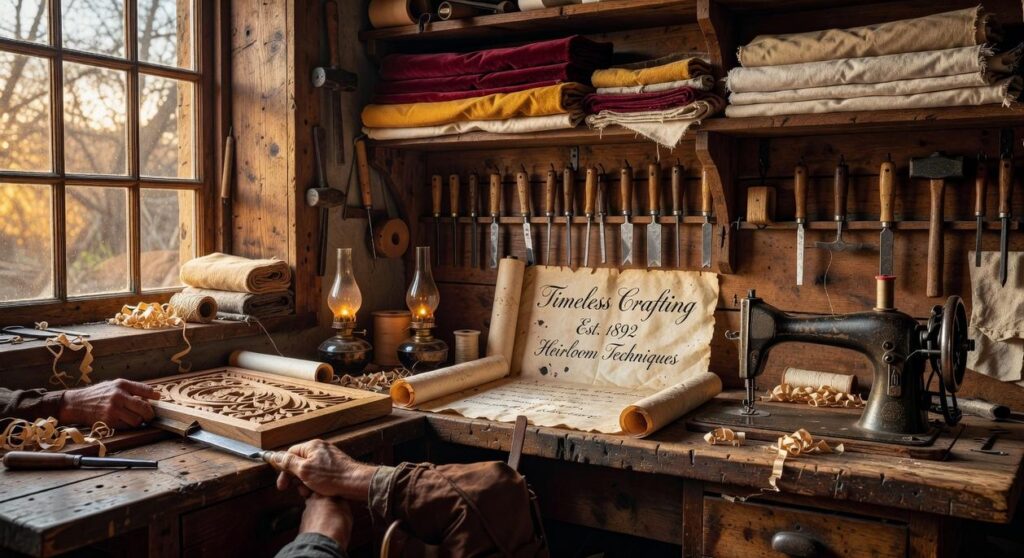
A Journey Through Timeless Crafting Techniques
As you explore the essential journals and publications every artisan should know, don’t miss the opportunity to deepen your creative perspective by also diving into our article on Understanding Abstract Art Styles and Their Origins.
There’s something humbling about learning a craft that refuses to be rushed. I learned that the hard way.
The Art of Bookbinding
At first, I treated Coptic stitch like decorative threading—until my pages fell out. Coptic stitch is an ancient binding method where sections of folded pages are sewn together through the spine, leaving the stitching exposed. The beauty? It lays completely flat, making it perfect for sketchbooks and journals. The exposed spine becomes part of the design (and yes, uneven tension will absolutely show).
By contrast, Japanese stab binding involves sewing single sheets together near the spine edge with intricate patterns. It’s elegant and ideal for loose pages, but it doesn’t lay flat. I once forced a Japanese stab-bound book open for writing and cracked the paper fibers along the margin. Lesson learned: structure dictates function.
The Tactile Impression of Letterpress
Then there’s letterpress. Unlike digital printing, where ink sits on top of paper, letterpress presses inked type into the sheet, creating a physical indentation known as a “bite.” That tactile depth is subtle but unmistakable. I once under-packed a press bed, thinking lighter pressure would be safer. The result? A faint, lifeless print. Too much pressure, however, bruises the paper. As noted in artisan journals and publications, proper makeready is everything.
The Flourish of Hand-Lettering
Finally, hand-lettering transforms text into image. Unlike standard typography, which relies on pre-designed fonts, hand-lettering is custom-drawn letter art. I used to overwork flourishes, crowding compositions. Eventually, I realized restraint creates impact. Sometimes the space around the letters speaks loudest (a lesson that took far too many smudged drafts to learn).
 Zayric Xenvale is the kind of writer who genuinely cannot publish something without checking it twice. Maybe three times. They came to artistic expression styles through years of hands-on work rather than theory, which means the things they writes about — Artistic Expression Styles, Specialty Reads, LWMF Artisan Project Spotlights, among other areas — are things they has actually tested, questioned, and revised opinions on more than once.