
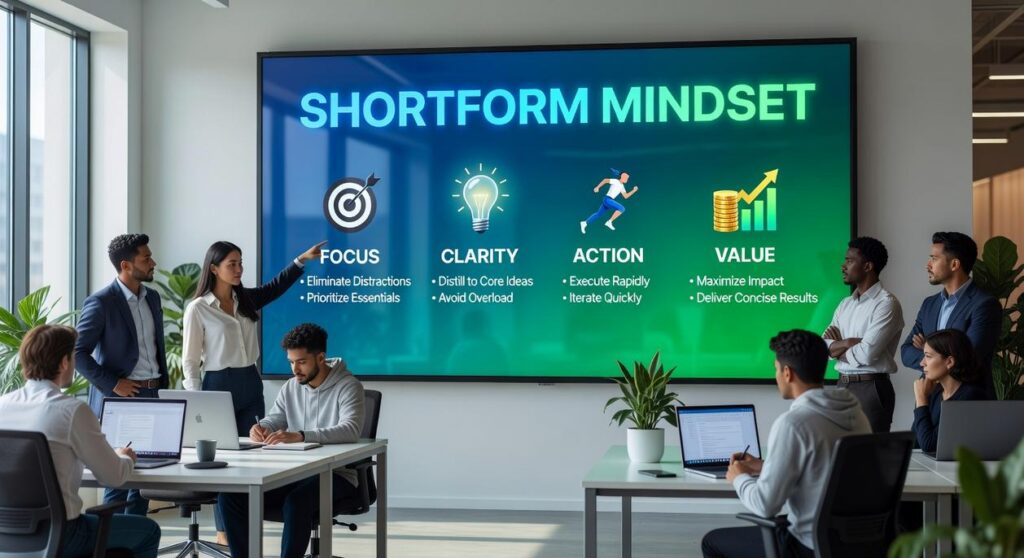
The Foundational Shift: Thinking Like a Short-Form Designer
As short-form video continues to dominate our online interactions, its dynamic visual storytelling techniques are reshaping design aesthetics, much like the diverse influences explored in understanding the origins of abstract art styles – for more details, check out our Understanding Abstract Art Styles and Their Origins.
Short-form video design influence isn’t about shrinking a long story. It’s about reframing how stories work.
From Storytelling to “Story-Showing”
Traditional storytelling builds context. Short-form demands instant clarity. Instead of explaining the journey of a resin pour, you show the swirl at its most hypnotic moment. Viewers don’t want the setup—they want the spark.
Some argue this cheapens creativity. That nuance gets lost. But here’s the counterpoint: constraint sharpens craft. Haiku didn’t kill poetry. It refined it. The same applies here. When you focus on feeling over exposition, you design for impact (and attention spans shaped by infinite scroll).
Define it simply: Story-showing means conveying the result or emotion in seconds, not minutes.
The Three-Second Contract
You have three seconds. That’s the contract. Break it, and viewers scroll.
Effective hooks in creative content include:
- A dramatic color mix mid-pour
- A hyper-satisfying texture press
- The first snap of a transformation
Research shows short-form engagement heavily depends on immediate visual stimulation (Meta Internal Data, 2023). So lead with motion, contrast, or surprise. Pro tip: start in the middle of the action, not before it.
Designing for the Loop
Loops aren’t accidents. They’re engineered. The final frame should visually echo the first—like sanding dust clearing back to a pristine surface. Seamless loops increase replays, which signals quality to algorithms (YouTube Creator Academy, 2024).
Most creators ignore this. That’s the gap.
Audio as a Co-Pilot
Don’t add music last. Choose it first. Let the beat dictate cuts, transitions, even tool taps. The rhythm becomes your invisible editor. (Think Baby Driver, but for crafts.)
Sound isn’t decoration. It’s structure.
Core Design Elements for High-Impact Creative Videos
High-impact creative videos aren’t just watched—they’re felt. The scrape of a palette knife, the soft thud of clay on a wheel, the crisp peel of tape revealing a razor-sharp paint line. When you design with the senses in mind, viewers lean in (even if they don’t realize why).
Pacing and Rhythmic Editing
First, let’s define rhythmic editing: cutting clips in sync with a beat or repeated motion to create flow. In a 15-second pottery clip, you might show 10 stages of shaping clay—each cut landing precisely on the music’s snare. The wheel spins, water glistens, fingers press inward. Snip. Snip. Snip. It feels like progress.
Some argue quick cuts overwhelm viewers. Fair point. But when done intentionally, fast pacing mirrors how audiences consume short-form content today (think of it as editing with a heartbeat).
Strategic Use of On-Screen Text
On-screen text isn’t just captions—it’s a design layer. Use it to drop a “Hack,” pose Ever tried this?, or list materials without slowing momentum. Clean typography floating over a buttery paint pour? That’s visual hierarchy in action—the arrangement of elements to guide attention.
Pro tip: Keep text high-contrast and positioned away from your focal action.
The Power of “Satisfying” Visuals (ASMR for the Eyes)
Visual ASMR highlights moments that feel good to watch: glossy resin settling flat, calligraphy ink gliding like silk, masking tape peeling with that faint zip. Neuroscience research suggests predictable, smooth visuals can trigger pleasurable responses in the brain (Reber et al., 2004).
Framing for a Vertical World
In a 9:16 frame, negative space (intentional empty areas) helps your subject breathe. Center detailed handwork; let tools enter from the top or bottom to guide the eye naturally.
| Element | Sensory Focus | Design Goal |
|---|---|---|
| Quick Cuts | Beat, motion |
Momentum |
| On-Screen Text | Visual clarity | Emphasis |
| Satisfying Visuals | Texture, flow | Emotional pull |
| Vertical Framing | Space, direction | Focus |
 Lynn Hallierones assisted in building the LWMF Crafts platform by contributing ideas and support that helped expand its creative direction. Hallierones worked alongside the team to highlight artisan projects and encourage a community centered around artistic exploration and hands-on crafting innovation.